Industry Expertise|Independent Intelligence|Sets the Standard
Every growing business reaches a point where the spreadsheets, workarounds and manual processes that got you this far start holding you back. We review how you actually operate, connect the systems you already have, and build what's missing — quickly, and at a cost that makes sense for your business.
A 2026 operational excellence study found that 61% of operations professionals admit they lack full visibility into the work being done across their own organisation. Separately, 71% say friction from fragmented tools and rigid, manual processes creates a genuine drag on their ability to respond to business challenges quickly.
For growing businesses, this usually isn't one big problem — it's a dozen small ones. A spreadsheet that only one person understands. A stock system that doesn't talk to the finance system. A process that was fine at half the size, and isn't anymore.
None of this is a reflection of how well a business is run. It is the natural result of growth outpacing the systems supporting it.
The tools and processes that worked when you were smaller rarely scale cleanly. Growth tends to outpace the systems supporting it — so workarounds get layered on top of workarounds, and nobody designed it that way. It just happened.
Stock numbers in one place, orders in another, finance in a third — each slightly out of sync with the others. Decisions end up being made on whichever number someone happened to check first, not the one that's actually right.
Fixing this properly often looks, from the outside, like it requires the kind of ERP system built for organisations ten times your size — with a price tag and implementation timeline to match. For most growing businesses, that is neither necessary nor realistic.
We start by understanding how your business actually runs — not how the org chart says it runs. Working directly with the people doing the work, we map out where time is lost, where information breaks down, and where manual effort is standing in for a process that could be automated.
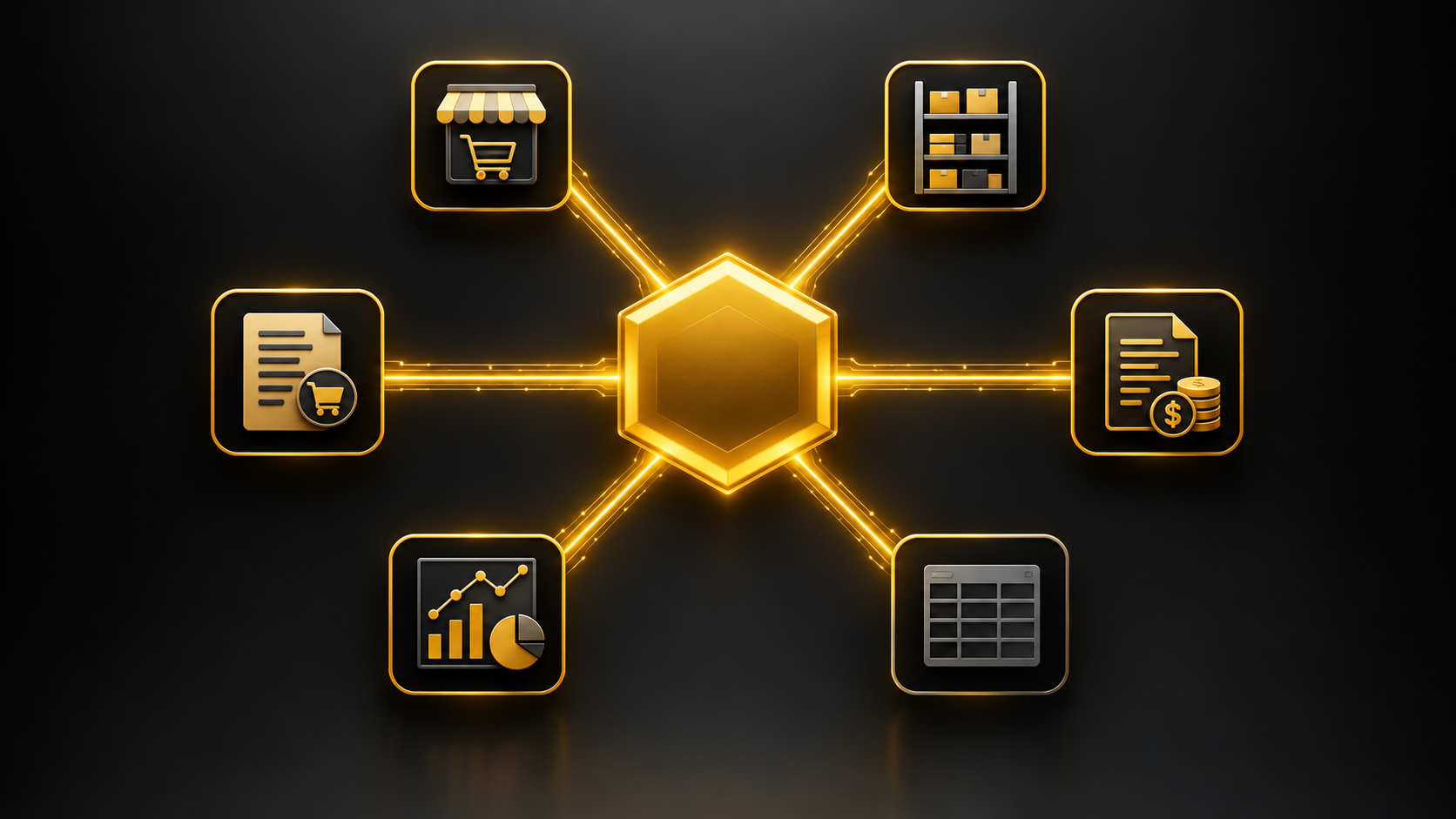
Rather than ripping out what you already have, we connect it. The systems you use for stock, orders, finance and customers are brought together so information flows automatically between them — and a clear, live dashboard gives you one accurate view of how the business is actually performing.
Where something genuinely needs to be built — a bridge between two systems, a tool that doesn't exist yet — we design and build it quickly and economically, using our own engineering background to deliver something fit for purpose without the overhead of an enterprise programme.
This isn't generic IT consultancy. It combines a genuine engineering and technical delivery background with a decade of process definition inside major business transformation programmes — applied at a scale and price point that works for growing businesses.
Start that conversation →Pinnacle's founder combines a technical and engineering background spanning some of the most demanding delivery environments with over a decade of process definition inside major business transformation programmes. That combination — genuine engineering capability and real process expertise — is unusual, and it's what makes rapid, cost-effective system integration possible.
An enterprise ERP implementation can take considerable time and prove costly — often disproportionate to what a growing business actually needs. Our approach is to get you the same clarity and control, built around the systems you already have, without that overhead.
The best engagements are built on collaboration. Here is what we have found makes the biggest difference in practice.
Not just the people who commission the work — but the people who actually use the systems and run the processes day to day. The more access we have to them, the sharper the picture we can build.
Our most useful conversations are the straightforward ones — including about the workarounds that everyone relies on but nobody's proud of. That honesty is where the real opportunities usually turn up.
The people who use a system every day are the ones who know what's actually wrong with it. We work with them, not just around them — it's what makes the result stick.
A short conversation is usually enough to tell whether there's a quick win, a bigger opportunity, or neither. No cost, no obligation.
Start the Conversation